
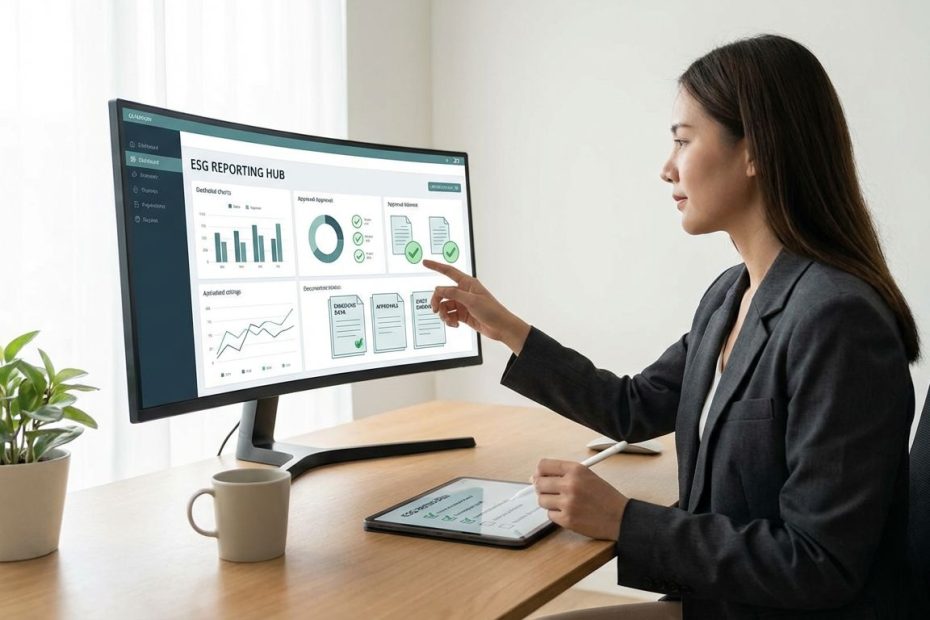
A sustainability management platform is no longer a “nice-to-have” system, it is the operational backbone you need to collect sustainability data once, control it like finance data, and reuse it across reporting, customer demands, and decision-making.
This article explains what an SMP is, why spreadsheets break at modern reporting speed, what “audit-ready” really demands, and how to select a platform that fits your company’s size and pressure points. You’ll leave with a practical operating model: what to centralize, what to automate, and what to lock down so reporting stops being a recurring fire drill.
What Is A Sustainability Management Platform, And How Is It Different From ESG Reporting Software?
A sustainability management platform (SMP) is the system you use to run sustainability like a business function, not a publishing exercise. It centralizes data collection, calculations, ownership, approvals, and evidence so your numbers stand up to scrutiny and can be repeated quarter after quarter without rebuilding the process.
Many teams start with “ESG reporting software” and end up disappointed because it behaves like a document factory. An SMP goes past output formatting and focuses on data intake, calculation logic, workflow, and controls. Forrester defines the market as software that performs sustainability data collection, calculation, and reporting to help organizations assess, plan, and execute sustainability strategies to meet demands from customers, regulators, and investors.
When the platform is doing its job, you stop asking, “Can we publish a report?” and start asking, “Do we trust the source data, can we trace it, can we update it without breaking history, and can we reuse it everywhere we get asked?” That shift is what turns sustainability into a managed operating discipline instead of a yearly scramble.
Why Do Businesses Need A Sustainability Management Platform Now, Not Later?
You need an SMP now because sustainability has become a recurring data and controls workload with real deadlines, not a one-off communications project. The pressure is coming from customers, lenders, procurement teams, and regulators, and the common thread is the same: they want consistent, defensible numbers that match what you claim.
In the EU, CSRD has put structure and timing around what must be reported and how. Companies are expected to prepare ESRS-aligned disclosures, and timelines step in by wave based on company type and listing status, which pushes organizations to build repeatable processes early rather than bolting controls on at the last minute.
In the U.S., state-level requirements add urgency even when details are contested. Deloitte’s DART update on California climate legislation noted CARB’s implementation work and referenced a proposed SB 253 reporting deadline concept of August 10, 2026, plus fee timing tied to that date. A separate AP report also describes legal disruption around California’s climate risk disclosure law (SB 261) while emissions reporting remains a live obligation.
Waiting sounds cheaper until you measure the cost of late-cycle remediation: re-collecting supplier data, reworking emission factors, re-approving changes, and re-explaining deltas to leadership. An SMP reduces that cost by making sustainability work behave like a monthly close instead of an annual rebuild.
Is A Sustainability Platform Really Better Than Spreadsheets For Carbon Accounting And Reporting?
Spreadsheets are fine for prototypes and early learning, and they fail the moment your reporting becomes repeatable, multi-owner, and evidence-based. The failure is not “spreadsheets are bad,” it is that spreadsheets cannot reliably enforce governance: you cannot guarantee version control across teams, you cannot maintain consistent calculation logic across time, and you cannot produce an audit trail without manual effort that defeats the point.
Carbon accounting is not only about getting a total number. It is also about explaining changes across periods and defending methodology choices. When you update an emission factor, adjust organizational boundaries, or correct a vendor dataset, you need a durable change log and supporting evidence that connects the new number to the old number without confusion.
Platforms win because they turn scattered files into managed processes: role-based permissions, approvals, linked evidence, consistent emission factor libraries, and controlled recalculation. That is how you keep leadership confidence when numbers move, and it is how you prevent staff burnout driven by constant rework.
What Problems Do Sustainability Platforms Solve First, And What Are The Fastest Wins?
The fastest wins usually come from stabilizing the work you already do: data intake, calculation consistency, and reporting cycle time. Most organizations don’t need a “big bang” program on day one. They need a system that makes the current process safer, faster, and easier to repeat.
Fast Win 1: Standardized Data Intake
You replace manual email chasing with structured requests, templates, validations, and reminders. You reduce data reformatting and stop losing time on mismatched units, missing periods, and unclear owners.
Fast Win 2: Consistent Calculation Logic
You move calculation assumptions out of personal spreadsheets and into shared logic with documentation. That one change reduces “mystery numbers” and protects you when staff changes happen.
Fast Win 3: Reporting Without Rebuilding
You reuse the same curated dataset across reporting outputs, customer questionnaires, and internal dashboards. A well-run platform makes your reporting cycle predictable, which matters more than fancy visuals.
Scope 3 is where these wins become unavoidable. Supply chain emissions typically dominate footprints, and primary data sharing is difficult when information is outside your control. A peer-reviewed review in npj Climate Action highlights that Scope 3 estimates are often based on averages, and it identifies key obstacles to primary data sharing: legal and regulatory challenges, missing interoperability, and data privacy concerns.
How Do Sustainability Management Platforms Support Audit-Readiness And Assurance?
Audit-readiness is not a single feature, it is the combination of ownership, traceability, and repeatability. You need named metric owners, clear data lineage from source to reported number, documented methodology, and approvals that show who reviewed what and when. If any of those pieces are missing, assurance becomes a manual evidence hunt.
A strong SMP supports audit-readiness by design: it captures source documents, ties them to the metric, tracks changes, and records approvals. That matters even more under regimes that expect controls maturity to increase over time, and it matters when multiple business units contribute data that must reconcile to a single external statement.
The practical benefit is executive confidence. When leadership asks, “Can we stand behind this?” you can answer with documented lineage and controlled calculations, not an informal explanation built from scattered files.
What Features Should You Look For In A Sustainability Management Platform In 2026?
Selection works when it starts with your operating reality, not a vendor demo. Your must-haves come from the work you repeat: collecting activity data, calculating emissions and other metrics, managing owners and approvals, and producing outputs that match the audiences you serve.
Prioritize features that reduce rework and increase defensibility:
- Data Integrations with ERP, utilities, travel, procurement, and emissions datasets so intake becomes automation, not copy-paste.
- Calculation Transparency so you can explain factors, methodologies, and assumptions without reverse-engineering spreadsheets.
- Version Control And Audit Trails so changes are tracked and time-stamped with accountable users.
- Workflow And Ownership for tasks, reviews, and sign-offs across sites and functions.
- Evidence Management so supporting documents stay attached to the metric, period, and method.
- Supplier Data Collection that supports structured requests and controlled updates for Scope 3.
- Reporting Outputs that map to your required disclosures and recurring customer questionnaires.
If vendor pages focus only on dashboards, treat that as a warning sign. Your biggest risk is not weak visuals. Your risk is weak controls, weak traceability, and slow cycle times.
Peer review marketplaces can help you short-list capabilities you care about, especially workflow management, audit trails, version control, permissions, and data integrity claims listed by vendors in this category.
Do Mid-Sized Companies Really Need ESG Software, Or Is It Only For Large Enterprises?
Mid-sized companies often need a platform earlier than expected because the trigger is rarely internal ambition. The trigger is external pull: customers demand product and supplier data, lenders request consistent metrics, and procurement requirements arrive with fixed deadlines. When these requests stack up, manual reporting becomes a capacity problem, not a strategy debate.
The common mistake is assuming “mid-sized” equals “simple.” Many mid-sized firms run complex multi-site operations, rely on contract manufacturing, or distribute through channels where customer requests arrive from multiple directions. If your value chain is complicated, your data workload is complicated, even if your headcount is not.
The other mistake is buying an enterprise tool that is priced and designed for large companies with large admin teams. Forrester notes that pricing approaches can influence vendor selection, including models that scale by supplier counts, which can become unworkable for organizations with hundreds of suppliers. Mid-market fit means controlled simplicity: enough governance to be defensible, enough automation to reduce labor, and enough flexibility to grow.
Regulatory exposure can also reach far past the Fortune 500. AP reported that California’s climate financial risk disclosure law applies to companies making more than $500 million a year that do business in California, and state estimates put the count of impacted businesses in the thousands. Even when lawsuits introduce uncertainty, operational readiness still matters because implementation can accelerate when dates become firm.
What Is A Sustainability Management Platform?
- Centralizes sustainability data
- Automates calculations and workflows
- Maintains audit trails and evidence
- Speeds reporting across rules and requests
Turn Sustainability Reporting Into A Repeatable Operating System
A sustainability management platform earns its place when it reduces effort, increases trust in the numbers, and keeps reporting cycles stable as requirements grow. You stop rebuilding spreadsheets, stop re-explaining the same metrics, and start managing sustainability data with the same discipline used for financial reporting. You also gain the ability to respond faster to customer and supplier requests without draining the team each quarter. If the business needs credible targets, reliable emissions tracking, and defensible disclosures, an SMP is the system that makes that work scalable. Make the purchase decision based on operating needs, then implement with clear owners, controlled methodologies, and automation tied to real data sources.
If this helped tighten your sustainability operations plan, follow the rest of the writing on my [] profile for more playbooks on building audit-ready metrics, supplier data flows, and executive-grade reporting.
References
- Forrester (Apr 17, 2024): Introducing The Sustainability Management Software Landscape Report And Forrester Wave™ Evaluation ([forrester.com](https://www.forrester.com/blogs/introducing-forresters-sustainability-management-software-landscape-and-wave/))
- Gartner Peer Insights: ESG Management And Reporting Software (category listings and vendor capability descriptions) ([gartner.com](https://www.gartner.com/reviews/market/esg-management-and-reporting-software))
- Grant Thornton: CSRD Reporting—What You Need To Know ([grantthornton.com](https://www.grantthornton.com/insights/articles/esg/2023/csrd-reporting-what-you-need-to-know))
- Deloitte DART (Dec 4, 2025): California Climate Legislation Update—Status of CARB Rulemaking and Next Steps ([dart.deloitte.com](https://dart.deloitte.com/USDART/home/publications/deloitte/sustainability-spotlight/2025/california-climate-legislation-reporting-updates-2026))
- Stenzel & Waichman, npj Climate Action (Mar 13, 2023): Supply-Chain Data Sharing for Scope 3 Emissions ([nature.com](https://www.nature.com/articles/s44168-023-00032-x))
- SIFMA (Sep 11, 2025): Implementation of SB 253 and SB 261 Following the August 21, 2025 Climate Disclosure Workshop ([sifma.org](https://www.sifma.org/advocacy/letters/implementation-of-sb-253-and-sb-261-following-the-august-21-2025-climate-disclosure-workshop))
- Associated Press (published ~Dec 2025): Federal appeals court pauses California law on climate change impact reports ([apnews.com](https://apnews.com/article/42708d5fc7ed15001f4ac5a870eb105d))

Yitz Stern is a New York–based entrepreneur and business consultant with 20+ years of experience in alternative funding and real estate. A former CEO of Fundry and managing director at Tiger Financial Technologies, he now advises mid- to large, non-public companies on capital strategy and scalable growth while investing in multifamily real estate