
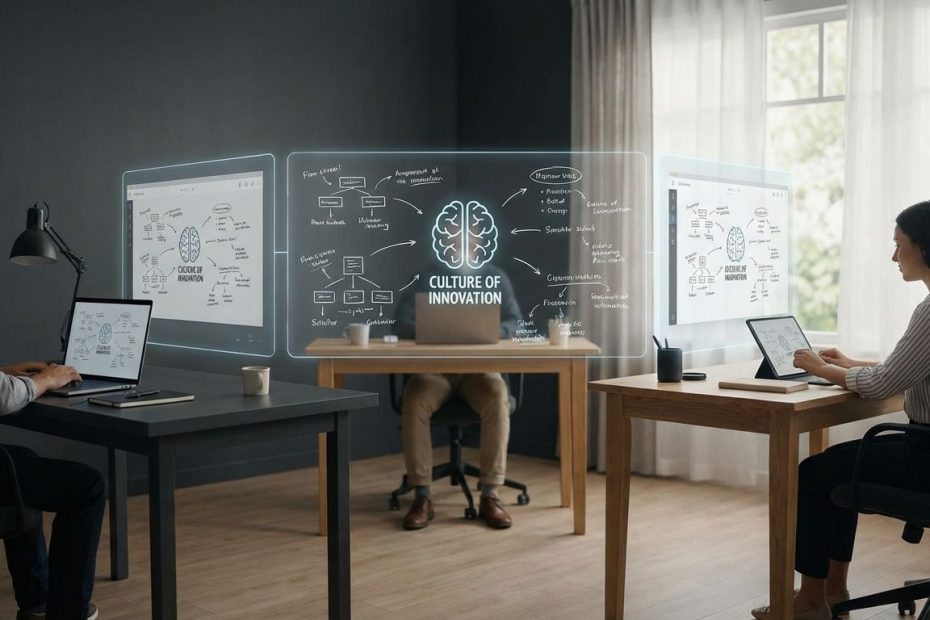
You create a culture of innovation in a remote workplace by making ideas visible, experimentation routine, and decision-making easy to follow. When your team has clear operating rules, strong documentation, and real room to contribute, remote work stops slowing innovation and starts widening it.
Remote teams do not build innovative cultures through office energy, chance conversations, or vague encouragement. You build it through systems people can trust, manager behaviors people can count on, and workflows that turn good ideas into tested improvements. This guide shows you where remote innovation breaks down, what to fix, and how to build a workplace where people share better ideas and move them forward faster.
How Do You Build A Culture Of Innovation In A Remote Team?
You build it by treating innovation as an operating discipline rather than a personality trait. In a remote workplace, people cannot rely on hallway updates, body language, or casual observation to understand what matters. They need a visible path for sharing ideas, getting feedback, and seeing what happens after they contribute. When that path is missing, innovation becomes political, inconsistent, and limited to the most vocal people.
The strongest remote teams make expectations explicit. Your employees should know where ideas go, who reviews them, how quickly feedback arrives, what qualifies for a small experiment, and how lessons get documented. This matters more in a distributed environment because hidden norms shut people out faster when there is no shared office routine to decode them. If your team members have to guess how decisions happen, they will protect their time instead of offering original thinking.
A written culture carries more weight in remote companies than a verbal one. Values like curiosity, speed, accountability, and initiative only become useful when they are attached to repeatable actions. That means public idea boards, simple proposal templates, experiment logs, decision records, and visible ownership. A team that writes down how innovation works creates equal access to participation across roles, regions, and time zones.
This is where many leaders misread the problem. They talk about wanting more creativity, then leave the mechanics undefined. A remote culture of innovation depends on operational clarity. You need a place where ideas are captured, a cadence for review, a rule for pilot testing, and a habit of sharing what worked and what failed. Once those patterns are in place, innovation stops feeling random and starts becoming part of how work gets done every week.
Research from Atlassian points to a major reason this structure matters: teams and leaders lose a large share of their time just searching for answers. That lost time weakens momentum, duplicates work, and drains the energy needed for new thinking. GitLab reinforces the same principle from an operating model angle with its emphasis on documented culture and no unwritten rules. If your people can quickly find decisions, past tests, and ownership details, they can build on prior work instead of restarting from zero.
You also need leadership behavior that matches the system. If senior leaders praise innovation but reward only speed, availability, and meeting participation, the culture will default to compliance. People notice what earns trust, budget, and recognition. If tested ideas, careful thinking, and documented learning receive visible support, your team will produce more of them.
Can Remote Teams Actually Be Innovative, Or Does Innovation Require In-Person Work?
Remote teams can be innovative, but they need stronger operating design than office-based teams. Innovation has never depended only on physical proximity. It depends on trust, clarity, fast access to knowledge, and a reliable way to turn early ideas into decisions. An office can make some collaboration easier, yet it can also hide poor habits behind constant availability and informal gatekeeping.
The old assumption that innovation requires everyone in the same room usually comes from a narrow view of how ideas emerge. Many valuable ideas do not appear during a live brainstorm. They develop through written reflection, cross-functional feedback, customer data, and gradual refinement. Remote teams can support that process well when they use asynchronous collaboration, decision logs, and shared documents that preserve thinking instead of letting it disappear after a meeting ends.
Remote work can widen participation in ways office-heavy models often do not. Employees who think best in writing, need time to refine ideas, or work in different time zones can contribute with more depth when the process is not dominated by whoever speaks fastest in a conference room. That creates a healthier flow of suggestions from different departments, backgrounds, and experience levels. More voices does not automatically produce better innovation, but broader input often improves the quality of options on the table.
What remote work does remove is accidental collaboration. You cannot assume ideas will spread through informal contact. That means leaders must replace informal osmosis with deliberate design. A remote team that depends on spontaneous chat will lose knowledge, stall decisions, and frustrate contributors. A remote team with strong documentation, review routines, and open channels for experimentation can move with much more consistency.
Current reporting and workplace research support this view. Great Place To Work argues that blaming remote work for weak innovation often misses deeper leadership and management failures. Harvard Online has also highlighted the link between remote work and open innovation, particularly when distributed work brings in broader thinking and more diverse problem-solving inputs. Reporting on companies operating successfully without office mandates points to documentation and intentional collaboration as practical enablers of innovation rather than barriers.
If your organization is asking whether remote teams can innovate, the better question is whether your operating model gives people enough context, autonomy, and support to do it. Remote work does not remove the ability to innovate. It exposes whether your company actually knows how innovation happens.
What Are The Biggest Barriers To Innovation In A Remote Workplace?
The biggest barriers are information silos, meeting overload, unclear ownership, weak trust, and delayed decisions. These problems are not exclusive to remote work, but remote settings make them easier to spot and harder to ignore. When people cannot find what they need, do not know who can approve a test, or feel disconnected from key conversations, innovation slows down long before anyone notices the damage in performance metrics.
Information friction is one of the most expensive failures in distributed teams. If your employees spend large parts of the week searching chat threads, old files, and disconnected tools for answers, they will have less time for experimentation and strategic thinking. Atlassian’s research on teams highlights how much work time gets lost to search and confusion. That issue matters far beyond productivity. It affects confidence, speed, and willingness to propose something new when the basics already feel hard to navigate.
Meeting overload creates a second drag on innovation. Remote organizations often respond to distance by scheduling more calls, more check-ins, and more updates. The result is a workday packed with coordination and very little room for focused thought. Microsoft’s Work Trend Index has pointed to the pressure modern work places on employees and the way low-value activity crowds out higher-value work tied to growth and innovation. If your calendar leaves no room for deep work, your culture will reward responsiveness over original thought.
Trust problems sit underneath many remote culture failures. People are less likely to share early-stage ideas when they expect silence, harsh judgment, or quiet dismissal. They also hesitate when decision-making is opaque and recognition flows unevenly. A weak trust environment does not always look dramatic. It often appears as delayed responses, guarded communication, reduced initiative, and a habit of waiting for approval on everything.
Unclear ownership is another frequent barrier. Innovation suffers when no one knows who decides, who funds a pilot, or who is responsible for follow-through. Remote teams need sharper accountability because they cannot rely on informal pressure to keep momentum alive. If you want new ideas to move, every proposal needs a visible owner, a review deadline, and a defined path from suggestion to test.
Engagement data adds an important correction to the usual debate. Gallup has reported stronger engagement among exclusively remote employees than among some other worker groups in remote-capable roles. That does not mean every remote team is healthy. It does mean remote work itself is not the automatic source of disengagement. The larger issue is how the work is managed, how information is shared, and whether employees have the support to contribute with confidence.
Community conversations among remote workers reinforce the same pattern in practical terms. People often describe culture problems as feeling unseen, missing informal learning, or being left out of important discussions until decisions are already made. Those are not abstract complaints. They are signs that the team lacks a reliable communication structure. If those problems stay unresolved, innovation drops because people stop investing energy in ideas they do not believe will travel.
How Do You Encourage Creativity And Idea-Sharing When People Work Remotely?
You encourage creativity by lowering the cost of contribution. People share more ideas when the process is simple, visible, and safe. In a remote setting, that means they do not need a perfectly polished proposal, a scheduled meeting, or insider access to be heard. They need a lightweight system that lets them submit a rough thought, receive useful feedback, and watch it move forward.
Asynchronous contribution is one of the biggest advantages remote teams can use better. Live brainstorms often reward speed, confidence, and seniority. Written idea prompts, shared documents, recorded comments, and time-boxed review windows create a more balanced environment. They give quieter contributors, international team members, and deep thinkers the same chance to shape the discussion. Your goal is not to eliminate live collaboration. It is to stop making live performance the only path to influence.
Psychological safety still matters, but it must be operationalized. Telling people to speak up is not enough. You need norms that protect unfinished thinking. Good remote teams separate idea generation from idea evaluation, ask reviewers to improve proposals rather than dismiss them, and recognize useful learning even when a pilot does not produce the expected outcome. When employees see that imperfect ideas receive serious attention, they contribute more freely and with better quality.
Managers should also make creativity part of regular work rather than a side activity. Monthly idea reviews, customer-problem roundups, after-action notes, and shared lists of recurring friction points all create raw material for improvement. If innovation only happens during a quarterly event, it will stay disconnected from the real work your team handles every day. Remote cultures stay more inventive when they turn ordinary operational pain into a routine source of ideas.
Technology can help here, but only when it serves the process. Owl Labs has reported broad employee use of artificial intelligence in daily work, and Microsoft has framed artificial intelligence as a way to free people from lower-value tasks. In practice, that means your team can use artificial intelligence for draft generation, meeting summaries, idea clustering, research synthesis, and knowledge retrieval. These tools do not replace human judgment. They reduce friction around early thinking and help people spend more time refining useful ideas.
GitLab’s guidance on remote culture also supports this more intentional style of collaboration. The company emphasizes written norms, regular one-to-one meetings, intentional informal communication, and visible values. Those habits matter because creativity is social. Even in a distributed workplace, people need confidence that their contribution will be understood, not lost in a feed, and not punished for being early or incomplete.
You should also watch for invisible participation gaps. If the same small group always submits ideas, comments first, or gets selected for pilots, your culture is not truly open. Rotate reviewers, invite input from customer-facing teams, and publish patterns from prior submissions so people know what strong contributions look like. A remote team becomes more innovative when idea-sharing feels normal, not risky or exclusive.
How Do Managers Support Innovation In A Remote Workplace?
Managers support innovation by removing friction, setting priorities, protecting time, and making decisions easier to execute. In remote teams, strong management is less about oversight and more about creating the conditions for steady contribution. Your people need enough clarity to act without waiting, enough support to take smart risks, and enough follow-through to trust that sharing ideas is worth the effort.
A supportive manager has an outsized effect on remote culture. Owl Labs has found that employees place major value on manager support, and that finding lines up with what seasoned remote operators already know. When a manager gives clear direction, responds with consistency, and helps unblock work quickly, employees stay engaged and willing to contribute beyond their assigned tasks. When that support is missing, people retreat into execution mode and stop volunteering ideas that might create extra uncertainty.
Priority discipline is one of the most underrated management skills in remote innovation. If your team is juggling too many goals, every new idea feels like noise. Managers need to define what kinds of innovation matter right now, which customer problems deserve attention, and what trade-offs are acceptable. This does not limit creativity. It focuses it. Teams generate stronger ideas when they know the business objective and the boundaries around effort, budget, and speed.
Managers also need to protect thinking time with intention. If a remote team spends the week moving from status call to status call, no one has the space to identify patterns, challenge assumptions, or build better proposals. Microsoft’s workplace research has emphasized how modern work patterns pull people away from high-value tasks. That signal matters at the manager level. If your calendar design punishes concentration, your innovation goals will remain rhetorical.
Recognition is another management lever that shapes culture fast. Praise only shipped wins, and your team will hide risky thinking until it looks safe. Recognize well-run experiments, clear problem statements, useful lessons, and strong collaboration, and you send a different message. People learn what the organization values by watching what gets visibility. If managers publicly reward useful learning, more employees will invest in it.
Feedback quality matters just as much as praise. In a remote setting, vague or delayed feedback can kill momentum faster than an outright rejection. Employees need specific guidance on what to improve, what evidence to gather, and what decision criteria matter. The stronger the feedback loop, the more likely ideas will mature instead of disappearing after initial submission.
Good managers also act as translators between leadership intent and day-to-day execution. They connect business goals to team experiments, keep decision paths short, and make sure credit is visible across locations and functions. If you want innovation to spread in a remote workplace, manager capability is not a supporting factor. It is one of the main drivers.
What Tools And Workflows Help Remote Teams Innovate Faster?
The best tools reduce search time, preserve decisions, and make collaboration visible without forcing constant meetings. The best workflows are asynchronous by default, documentation-driven, and selective about live discussion. Remote innovation does not improve when you stack more software into the workday. It improves when every tool has a clear role in capturing, organizing, discussing, and advancing ideas.
Start with your knowledge layer. If people cannot find past decisions, customer feedback, project history, or ownership details, they will repeat work and slow down every new initiative. Atlassian’s research on time lost searching for answers makes this point sharply. Documentation is not administrative overhead in a remote workplace. It is part of the infrastructure that allows new ideas to move with speed and consistency.
Your communication workflow also needs separation by purpose. Use one channel for discussion, another for formal decision records, another for project tracking, and another for knowledge storage. When everything happens inside chat, valuable thinking disappears into volume. A remote team that innovates well usually treats chat as a signal layer, not a permanent archive. The durable parts of work live in documents, project systems, and searchable repositories.
Idea capture needs to be easy and standardized. A simple template works better than a blank page. Ask contributors to define the problem, explain why it matters, note possible impact, identify dependencies, and propose a low-cost test. That structure helps reviewers respond faster and makes comparisons easier across submissions. It also improves idea quality over time because employees learn what strong proposals require.
Decision workflows should be short and visible. Every proposal needs an owner, a deadline for review, a documented outcome, and a record of why the decision was made. That eliminates ambiguity and cuts down on endless revisiting. It also creates a useful archive for future work. When teams can see what was tested, approved, delayed, or rejected, they gain a shared memory that supports faster innovation later.
Artificial intelligence now has a practical place in this stack. Microsoft’s Work Trend Index and Owl Labs’ reporting on employee use of artificial intelligence point to the same direction of travel: workers are already using these tools to reduce repetitive effort. In remote innovation workflows, artificial intelligence can summarize meetings, pull themes from idea submissions, surface related documentation, draft proposal outlines, and reduce the friction of cross-team knowledge sharing. The benefit is not novelty. The benefit is speed and clearer access to information.
The strongest workflow design usually follows four jobs: capture ideas, coordinate work, synthesize information, and record decisions. That sequence keeps momentum visible and prevents strong ideas from getting trapped in discussion. If your tools support those jobs cleanly, your team will spend less time chasing context and more time improving products, services, and internal operations.
How Do You Measure Whether A Remote Culture Is Actually Becoming More Innovative?
You measure innovation culture through behavior, throughput, and learning speed. Slogans, engagement scores, and pulse surveys can help, but they do not tell the full story. If you want to know whether your remote workplace is becoming more innovative, track what people submit, what gets tested, how quickly decisions happen, and how well learning spreads across the organization.
Start with contribution metrics. Look at how many employees submit ideas during a quarter, which teams contribute most often, and whether participation is concentrated among a small group. A healthy innovation culture shows broad involvement, not just a handful of repeat contributors. If only managers or product teams generate ideas, your system may be excluding valuable operational knowledge from other parts of the business.
Then measure conversion. How many ideas move from suggestion to review, from review to experiment, and from experiment to scaled adoption? This reveals whether your organization is serious about execution or simply collecting ideas without commitment. A remote workplace can generate plenty of discussion and still fail to innovate if nothing moves past the talking stage.
Speed is another critical indicator. Track the average time from proposal to first response, from first response to decision, and from decision to pilot launch. Long delays weaken trust and reduce participation. People stop contributing when the process feels like a holding area rather than a path to action. Faster cycles create a stronger feedback loop and help employees see that their thinking can shape outcomes.
You should also measure knowledge reuse. How often do teams refer to earlier experiments, shared lessons, or archived decisions when launching new work? Atlassian’s findings on search-time waste show why this matters. If employees cannot locate previous learning, the organization pays for the same mistakes twice. A remote culture of innovation strengthens when teams can retrieve relevant knowledge quickly and apply it to new problems.
Engagement remains useful as a supporting signal, especially when paired with operational measures. Gallup’s reporting suggests remote employees can be strongly engaged, but engagement alone does not guarantee innovative output. You need to compare morale with action. Are engaged teams actually shipping more experiments, learning faster, and collaborating across functions, or are they simply satisfied with their day-to-day routines?
A practical measurement set usually includes idea submission rate, idea-to-experiment conversion, time to decision, cross-functional collaboration rate, documented lessons learned, reuse of prior knowledge, and retention among high contributors. These indicators give you a more accurate picture than culture slogans ever will. If those numbers improve over time, your remote culture is becoming more innovative in ways that affect business performance.
What Daily Habits Make Remote Innovation Sustainable Instead Of Temporary?
Sustainable innovation comes from habits your team can maintain during busy periods, not from occasional bursts of energy. Remote workplaces lose momentum when innovation lives only in special projects or leadership speeches. You need routines that fit into normal work and keep fresh thinking active without demanding a separate program every month.
One useful habit is weekly written reflection on friction. Ask teams to note recurring customer issues, internal delays, tool failures, approval bottlenecks, and repeated manual work. This turns everyday pain points into a steady source of improvement ideas. It also keeps innovation tied to real business conditions rather than generic brainstorm topics that rarely lead to action.
Another habit is visible learning. After a pilot, publish a short note on what was tested, what happened, what changed, and what the team recommends now. That discipline creates institutional memory and strengthens trust in the system. Employees are more willing to contribute when they can see that experiments produce learning, not just judgment.
Regular one-to-one conversations remain important as well. Remote employees often reveal better ideas in smaller, direct conversations than in large group calls. A strong manager listens for patterns, surfaces good thinking into the wider system, and gives people credit for their contributions. GitLab’s emphasis on intentional communication and ongoing manager connection reflects how essential these interactions are in distributed companies.
You should also normalize small tests over large proposals. When every idea appears to require a polished business case, the pipeline dries up. Encourage employees to define low-cost experiments with clear boundaries and expected learning. This keeps innovation practical and reduces fear around proposing something that is not yet fully formed.
Recognition should happen often and in public. Highlight useful problem statements, smart pilot design, cross-team collaboration, and well-documented lessons, not just major wins. That keeps the signal broad and tells your team that innovation includes disciplined thinking, not just breakthrough moments. Over time, those repeated cues shape what people pay attention to and how they choose to contribute.
If you embed these habits into meetings, manager routines, project reviews, and knowledge systems, innovation stops feeling like extra work. It becomes part of how your remote workplace solves problems, allocates attention, and improves performance every week.
How Do You Create A Culture Of Innovation In A Remote Workplace?
- Document how ideas are submitted, reviewed, tested, and approved.
- Use asynchronous collaboration to widen participation.
- Reduce meeting overload and protect focused work time.
- Give managers clear responsibility for support, feedback, and follow-through.
- Measure idea flow, decision speed, experiments, and shared learning.
Build The Remote Team People Want To Contribute To
A culture of innovation in a remote workplace is built through clarity, trust, and disciplined execution. When you document expectations, reduce search friction, protect time for real thinking, and make idea-sharing safe and visible, your team produces stronger work with less waste. Manager quality, knowledge access, and decision speed shape remote innovation far more than physical location ever will. If you want better ideas, build a workplace where people can find what they need, understand how to contribute, and see that useful thinking leads to action. Once that system is in place, innovation stops depending on energy and starts depending on how well you run the company.
References
- State of Teams 2025 – Work Life by Atlassian
- Building And Reinforcing A Sustainable Remote Work Culture | The GitLab Handbook
- These Companies Innovate And Collaborate Without Office Mandates – The Washington Post
- Remote Work Isn’t The Reason Your Company Can’t Innovate | Great Place To Work
- Is Remote Work The Key To Increasing Open Innovation? | Harvard Online
- Global Employee Engagement | Gallup
- State Of Hybrid Work 2025 | Owl Labs
- Microsoft Annual Work Trend Index
- How Do You Maintain Culture With A Fully Distributed International Team? | Reddit
- What’s The Most Effective Culture-Building Habit You’ve Seen In A Remote Team? | Reddit
- General Advice On How To Make Remote Team Collaboration Successful | Reddit

Yitz Stern is a New York–based entrepreneur and business consultant with 20+ years of experience in alternative funding and real estate. A former CEO of Fundry and managing director at Tiger Financial Technologies, he now advises mid- to large, non-public companies on capital strategy and scalable growth while investing in multifamily real estate