
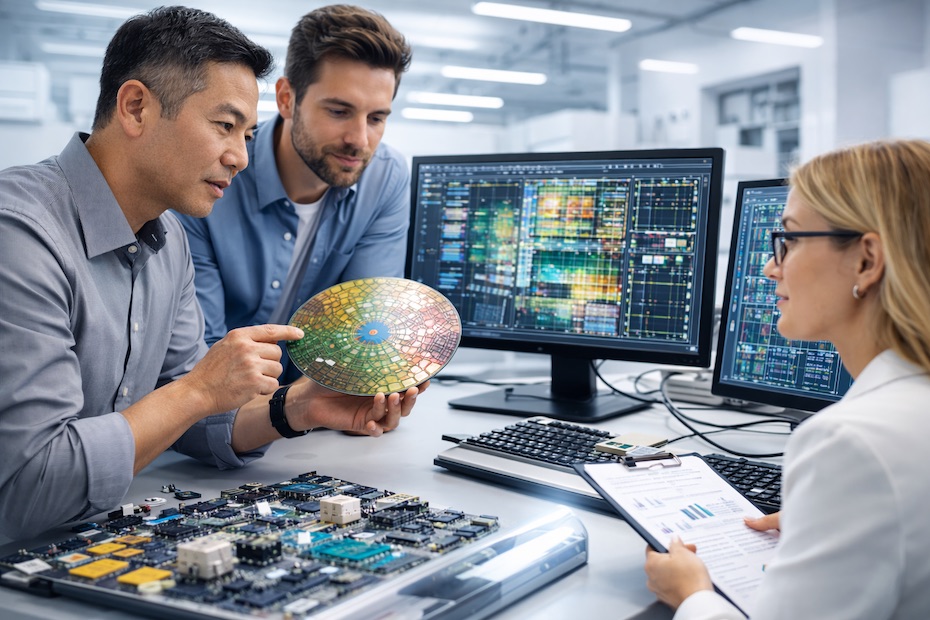
Application-specific semiconductors power modern technology by delivering hardware built for a single, high-value task with unmatched speed, efficiency, and reliability. You rely on these chips whenever performance, energy control, or real-time processing must exceed what general-purpose processors can deliver.
This article explains how application-specific semiconductors are shaping the next phase of technology. You will see where they outperform traditional chips, why industries are investing heavily in them, and how they influence everything from AI infrastructure to connected devices.
What Are Application-Specific Semiconductors?
Application-specific semiconductors, commonly referred to as ASICs, are chips engineered to execute a defined workload directly in silicon. You are not dealing with flexible computing hardware designed to handle many tasks. You are working with hardware created to do one thing extremely well.
This design approach removes unnecessary instructions, control logic, and overhead. Each circuit exists for a purpose tied directly to the target workload. The result is predictable execution, lower latency, and tighter power control.
You encounter application-specific semiconductors inside smartphones, networking hardware, data centers, and embedded systems. Whenever performance consistency matters more than flexibility, these chips become the preferred choice.
How Do Application-Specific Semiconductors Differ from CPUs and GPUs?
CPUs and GPUs prioritize versatility. You can assign them new tasks through software, but that adaptability comes with overhead. Instruction decoding, memory scheduling, and general control logic consume power and time.
Application-specific semiconductors remove that burden. You encode the workload directly into hardware pathways. This shift allows faster execution per clock cycle and reduces wasted energy.
You trade flexibility for efficiency. That trade makes sense in environments where workloads remain stable, predictable, and performance-critical. Data processing pipelines, cryptographic functions, and signal handling all benefit from this hardware-level specialization.
Why Are Application-Specific Semiconductors Critical for AI Workloads?
AI systems demand sustained mathematical throughput and precise data movement. General processors struggle to maintain efficiency when models scale in size and complexity.
Application-specific semiconductors embed AI operations directly into silicon. Matrix calculations, tensor processing, and memory access patterns are hard-wired for the task. You gain faster inference, lower power draw, and consistent latency.
This efficiency becomes essential when deploying AI at scale. Training clusters, edge devices, and inference engines all benefit when compute density increases without proportional energy growth. Custom silicon allows AI systems to scale responsibly rather than relying on brute-force compute.
Where Do Application-Specific Semiconductors Deliver the Most Value?
You see the strongest returns where performance limits directly affect cost, safety, or user experience.
In telecommunications, application-specific semiconductors manage packet routing, signal modulation, and network timing with strict latency requirements. Software-driven systems struggle to match this consistency at scale.
In consumer electronics, these chips control cameras, biometric sensors, and power systems. They allow devices to deliver advanced features without draining batteries or increasing heat output.
In industrial and embedded systems, application-specific semiconductors provide deterministic behavior. Manufacturing equipment, robotics, and automation platforms depend on this predictability to operate safely and efficiently.
How Do Application-Specific Semiconductors Improve Energy Efficiency?
Energy efficiency becomes a strategic advantage as computing moves closer to physical limits. General processors waste energy on unused instructions and control paths.
Application-specific semiconductors eliminate that waste. Every transistor supports the target workload. You reduce switching activity, memory traffic, and clock cycles that do not contribute to results.
This efficiency directly impacts operating costs. Data centers reduce cooling needs. Mobile devices extend battery life. Edge systems operate longer without power infrastructure upgrades. Across sectors, energy efficiency becomes a competitive advantage rather than a technical detail.
What Are the Trade-Offs of Using Application-Specific Semiconductors?
You gain performance and efficiency, but not without cost. Designing an application-specific semiconductor requires significant upfront investment. You commit to architecture decisions long before manufacturing begins.
Once fabricated, functionality remains fixed. If algorithms change or requirements shift, redesign becomes necessary. This limitation demands careful planning and confidence in workload stability.
Development timelines also extend. Validation, fabrication, and testing require coordination across multiple disciplines. These chips make sense when long-term volume and performance gains justify the investment.
How Are Application-Specific Semiconductors Influencing Cloud Infrastructure?
Cloud platforms prioritize efficiency at massive scale. Small performance gains compound into meaningful cost reductions when multiplied across thousands of servers.
Application-specific semiconductors enable providers to offload specific workloads from general processors. Networking, storage acceleration, security processing, and AI inference all move onto custom hardware.
You gain predictable performance, reduced power usage, and tighter control over infrastructure behavior. This shift allows cloud platforms to deliver higher service levels without linear cost increases.
What Role Do Application-Specific Semiconductors Play in Emerging Technologies?
Emerging technologies push hardware beyond traditional limits. Autonomous systems process sensor data in real time. Advanced connectivity platforms handle massive data flows with minimal delay.
Application-specific semiconductors meet these demands by embedding decision paths directly into hardware. You reduce reliance on software scheduling and minimize response times.
As devices become more intelligent and autonomous, this form of silicon specialization becomes essential. It supports real-time operation where software latency introduces unacceptable risk or inefficiency.
How Is the Application-Specific Semiconductor Market Evolving?
Demand for application-specific semiconductors continues to rise across industries. Organizations seek control over performance, cost structure, and system behavior.
Manufacturing advances allow more complex designs within tighter power envelopes. At the same time, design tools reduce development barriers for specialized silicon.
You see a clear trend toward hardware built around workloads rather than software adapted to hardware. This shift reshapes how technology platforms are conceived, built, and scaled.
Application-Specific Semiconductors Explained
- Custom chips built for one defined task
- Higher performance with lower energy use
- Used in AI, networking, and embedded systems
- Preferred when consistency and efficiency matter
Building the Next Generation of Technology with Purpose-Built Silicon
Application-specific semiconductors redefine how performance is achieved across modern systems. You move beyond general processing toward hardware aligned with real operational needs. This alignment delivers speed, efficiency, and reliability that software alone cannot match. As technology demands continue to intensify, specialization becomes a strategic requirement rather than an option. Organizations that invest in purpose-built silicon position themselves to lead the next era of innovation.

Yitz Stern is a New York–based entrepreneur and business consultant with 20+ years of experience in alternative funding and real estate. A former CEO of Fundry and managing director at Tiger Financial Technologies, he now advises mid- to large, non-public companies on capital strategy and scalable growth while investing in multifamily real estate