
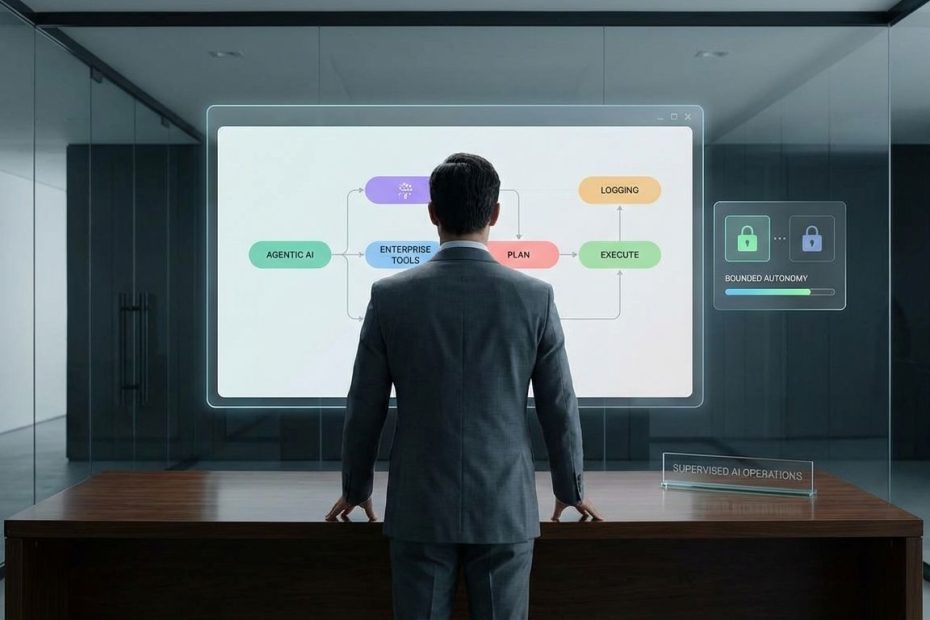
Agentic AI changes human-machine collaboration by moving AI from “answering” to planning and executing work across your tools, with supervision, permissions, and auditability built into the operating flow.
You stop treating AI as a chat window and start treating it as a new kind of teammate: one that can take tickets, push updates, run checks, draft artifacts, and hand you decisions that are already shaped by real system actions. This article shows how to define “agentic” without getting fooled by rebranding, where it delivers measurable value, what breaks in production, and how to deploy bounded autonomy without slowing teams down.
What Is Agentic AI, And How Is It Different From A Chatbot Or Copilot?
Agentic AI refers to systems that can take a goal you give them, break it into steps, select tools, execute actions, and adjust based on outcomes. You measure it less by how well it talks and more by how reliably it completes multi-step work without you babysitting every click. When it works, you delegate a task, not a prompt.
The practical difference shows up in tool use. A chatbot summarizes a policy, an agent updates the policy page, opens a change request, routes it for approval, then posts the result where your team already works. A copilot may assist inside one app, an agent crosses apps and keeps state across steps, which is where real automation starts and where risk also expands.
Keep the definition tight when vendors pitch “agentic” features. If the system cannot operate with permissioned tool access, produce an audit trail of actions, and recover from partial failure without corrupting data, it behaves more like an assistant with macros than an agent you can assign work to.
Are Teams Actually Using Agentic AI In Real Workflows Or Mostly Demos?
Real usage exists, and it concentrates where work is repetitive, systems are API-accessible, and rollback is possible. Teams put agents into service ops, IT operations, internal enablement, and security triage because the work already has tickets, logs, queues, and defined handoffs. Those conditions let you control scope and prove value quickly.
Production reliability stays uneven, and the gap from demo to daily operations is where most programs stall. What fails is rarely the model’s ability to generate text, it is the total system’s ability to handle stale permissions, missing fields, brittle integrations, rate limits, changing schemas, and human exceptions. When your environment is messy, the agent must handle mess without inventing actions.
You can spot mature deployments by how they treat escalation. The best teams do not expect an agent to “finish everything.” They expect it to finish the routine path, then route exceptions to humans with the evidence already collected and the next action pre-filled.
Where Does Agentic AI Redefine Collaboration The Fastest In 2026?
Collaboration changes fastest where humans and machines already share a queue of work and where decisions depend on multiple systems. Security operations is a prime candidate because triage requires pulling telemetry from many sources, correlating it, and driving consistent response steps. Agentic patterns fit the workload: enrich, classify, contain, document, escalate.
Support and service operations follow the same shape. The agent reads the customer issue, checks entitlements, pulls relevant internal guidance, drafts a response, executes the approved action in the right system, and records what happened for downstream teams. Humans shift to reviewing edge cases, handling policy calls, and managing customer relationships rather than copying data across tabs.
Search and commerce experiences are also moving toward “done-for-you” flows. When the search layer becomes agentic, you stop reading ten links and start approving an action plan: schedule, purchase, compare, reserve, submit. That changes collaboration outside the enterprise too, because customers arrive with decisions already shaped by agent behavior, not only by information retrieval.
How Fast Will Agentic AI Spread Across Enterprise Software?
Adoption inside software products is accelerating because vendors can embed task-specific agents into existing workflows without waiting for every customer to build from scratch. Gartner’s forecast that a large share of enterprise apps will include task-specific agents by the end of 2026 captures the direction: agents are moving from optional experiments to default product surfaces in core systems. That shift matters because distribution beats novelty, the capability shows up where work already happens.
At the same time, project success rates will not match feature rollout rates. Gartner also warns that a large portion of agentic AI projects will be canceled by the end of 2027, which aligns with what shows up in practitioner conversations: costs are easy to underestimate, governance is easy to postpone, and end-to-end ownership gets blurry when an agent crosses multiple teams’ systems.
Plan for uneven outcomes. You will see agents spread quickly across SaaS platforms, and you will also see many internal builds stall when teams cannot get clean tool contracts, stable data access, and enforceable operating rules. Winning programs treat agents as part of the operating model, not a bolt-on plugin.
What Changes In Human-Machine Collaboration When AI Can Take Actions?
The collaboration contract changes from “ask and answer” to “assign and verify.” Your job shifts toward setting intent, constraints, and acceptance criteria, then reviewing what the agent did with evidence. The agent’s job becomes execution within lanes you define, with fast escalation when it hits ambiguity.
This also changes how teams communicate. Instead of asking coworkers for status updates, you ask the agent for a validated state that is backed by system checks: what changed, where it changed, who approved it, and what is still blocked. That reduces meetings when the environment supports trusted telemetry and audit logs, and it also reduces the political friction that comes from inconsistent reporting.
Management habits also change. You start measuring throughput, rework, and exception rates at a finer granularity because the agent produces structured traces. That makes operations more measurable, and it also exposes broken processes that humans have been patching with informal workarounds for years.
What Are The Biggest Risks When Agentic AI Can Execute Work?
The risk profile shifts from “bad output” to “bad outcomes.” A hallucinated paragraph is annoying, an incorrect permission change, invoice update, or endpoint action is operational damage. When agents gain tool access, your security model must assume that prompts, content, and external inputs can steer behavior unless you constrain what the agent is allowed to do and verify what it actually did.
Prompt injection becomes more than a content issue when the agent can click, query, and submit. If an agent reads untrusted text and treats it as instructions, it can leak data, misuse credentials, or execute unintended actions. You mitigate that with strict tool gating, action confirmation rules for sensitive operations, and separation between “read” tools and “write” tools until confidence is earned.
Governance failures show up in ownership gaps. If no one owns the end-to-end outcome across systems, the agent becomes a fast way to create cross-team incidents. The fix is unglamorous: defined permissions, logged actions, rollback plans, and clear escalation paths that map to existing on-call and approval structures.
What Do Practitioners Say Is Hardest About Building Or Operating Agentic AI?
Reliability in messy environments is the hardest part, and it has nothing to do with how polished your demo looks. Agents fail when APIs change, when fields are missing, when systems time out, when rate limits hit, or when the “right action” depends on tribal knowledge that never made it into policy. Humans handle those gaps with judgment and social coordination, agents need explicit rules and recoverable steps.
Definitions also cause friction. Teams argue about whether a workflow counts as an agent, and that argument wastes time unless you tie it to operational criteria. If the system cannot plan across steps, maintain state, use tools safely, and recover from partial failure, it remains automated with a chat wrapper. Call it what it is, then decide whether it is good enough for the target process.
Orchestration is another recurring pain point. Multi-agent designs can amplify errors when handoffs are unclear, memory is stale, or two agents attempt conflicting writes. Stable deployments reduce concurrency, keep responsibilities narrow, and introduce deterministic checks at key points before any irreversible action occurs.
How Do You Build “Bounded Autonomy” That Teams Trust?
Bounded autonomy means the agent can act, but only inside well-defined lanes. You start with tasks that have clear success criteria and limited downside, then expand scope as the agent proves stable behavior. This is not a philosophy, it is an operating choice that keeps your program alive long enough to mature.
Boundaries come from permissions, policies, and verification. Your agent should have the minimum set of tool permissions needed to complete the task, and sensitive actions should require a human approval step until the error rate is demonstrably low. Verification matters as much as execution: require the agent to show evidence from systems of record rather than relying on its own narrative of what happened.
You also need observability that matches production reality. Log every tool call, store the inputs and outputs that matter, and track failure modes by category. When an agent fails, the postmortem should look like any other operational incident review: what broke, why it broke, how to prevent recurrence, and what guardrail catches it earlier next time.
How Do You Spot Agent-Washing When Vendors Sell “AI Agents”?
You can cut through marketing by asking a few operational questions. Can the product execute multi-step workflows across tools, or does it only suggest steps for humans to click? Can it hold state across steps, or does each action reset unless you paste prior context? Does it produce an auditable action trail that your compliance and security teams can review?
Tooling and control surfaces expose the truth. Mature agent products include permission scoping, environment separation, testing modes, policy enforcement, and rollback options. If the product treats tool access as an afterthought, you inherit risk and operational toil.
Procurement should demand measurable proof. Require a sandbox trial that mirrors your real toolchain, measure task completion rate, exception rate, and time-to-resolution, then stress-test with messy inputs that match your day-to-day reality. If the agent only performs on scripted paths, the purchase creates a demo trophy, not a production asset.
Will Agentic AI Replace Jobs Or Change How Teams Work?
In most organizations, the near-term change is work recomposition. The agent absorbs routine steps, and people move toward review, exception handling, stakeholder communication, and higher-leverage decisions. You get the biggest gains when you stop forcing humans to act as glue between systems and you let agents do the glue work under supervision.
Team design shifts when agents can own queues. You may run leaner front-line teams for routine issues, then invest more in specialists who handle complex cases and who design the operating rules that keep automation safe. This raises the importance of process owners, knowledge owners, and platform engineers who can keep tool contracts stable.
Performance expectations also change. When an agent can execute in minutes what used to take hours of human coordination, tolerance for internal delays drops. Teams that modernize their approval flows and clean up their data access policies will capture the speed, teams that keep old bottlenecks will watch the agent pile up work it cannot complete.
What Is Agentic AI In Simple Terms?
- Agentic AI plans and completes multi-step tasks
- It uses tools, takes actions, and keeps state
- You supervise outcomes with permissions and audit logs
Put Agentic AI To Work Without Losing Control
Agentic AI earns its place when it executes real work inside your systems, with tight permissions, visible evidence, and disciplined escalation. You get the best results by starting with bounded autonomy, measuring completion and rework, then expanding scope based on operational performance, not vendor promises. Keep your definitions strict, treat observability and security as day-one requirements, and insist on auditability that stands up to real incident review. When you run the program that way, human-machine collaboration becomes faster, calmer, and more measurable, because the agent stops being a chat tool and starts being a managed operator in your workflow.
References
- BCG: Agentic AI Blurs Line Between Tool and Teammate
- Associated Press: What Does ‘Agentic’ AI Mean?
- Gartner: 40% of Enterprise Apps Will Feature Task-Specific AI Agents by 2026
- Gartner: Over 40% of Agentic AI Projects Will Be Canceled by End of 2027
- Axios: Security Teams Embrace Agentic AI
- ITPro: Agentic AI Poses Major Challenge for Security Professionals
- Google: AI Mode in Search Adds Personalization and Agentic Features
- Reddit: Agentic AI in Real Business Workflows Discussion
- Reddit: Agentic AI in Real IT Workflows Discussion
- Reddit: Do AI Agents Actually Exist Discussion

Yitz Stern is a New York–based entrepreneur and business consultant with 20+ years of experience in alternative funding and real estate. A former CEO of Fundry and managing director at Tiger Financial Technologies, he now advises mid- to large, non-public companies on capital strategy and scalable growth while investing in multifamily real estate