
Your personal brand is your credibility, made searchable, it reduces perceived risk for buyers, partners, candidates, and investors before you ever get a meeting. Build it with proof, a clear point of view, and consistent visibility, not with constant posting or forced hype.
This guide shows how to decide whether founder-led branding is worth your time, choose the right platform, optimize LinkedIn as a conversion asset, publish content that sounds like you, keep a cadence that survives real operating weeks, and measure ROI in outcomes the business respects. After reading, you can set a 90-day operating plan, tighten your online footprint, and run personal-brand work like a predictable growth channel.
Do You Really Need A Personal Brand As A Founder, Or Can The Company Brand Do The Work?
You need a personal brand when trust and speed matter more than feature checklists. That typically includes B2B SaaS, agencies, services, recruiting-heavy companies, fundraising cycles, and anything sold through relationships. In these motions, people research the founder even when they claim they only care about the product, and a thin online footprint creates friction that sales, hiring, and partnerships must overcome repeatedly.
You can lean on the company brand when distribution does not depend on you being visible, like SEO-led ecommerce, commodity products, or businesses built on paid acquisition with tight unit economics. Even then, a founder brand still protects the downside. When something goes wrong publicly, when a candidate wants to verify leadership quality, or when a partner wants to assess credibility, the founder’s presence becomes the fastest trust signal.
Use a simple test that matches how real decisions happen: if prospects, candidates, partners, or investors search your name before responding, the personal brand already exists, it is just unmanaged. Founder communities argue about whether this is a “game,” yet the practical truth stays stable: people make decisions with incomplete information, and the online footprint fills in the gaps. Personal branding is not a vanity project, it is a risk-control layer that reduces uncertainty for other people.
For B2B, there is also a measurable demand-gen effect. Research shared by LinkedIn and Edelman reports that many decision-makers say a piece of thought leadership prompted them to research a product or service they were not considering. That is the exact outcome of founder-led content targets: getting into the consideration set before the formal buying process begins.
Where Should You Start Building Your Personal Brand Online In 2026: LinkedIn, X, YouTube, TikTok, Or A Newsletter?
Start with a “home base” you control, plus one primary distribution platform. The home base is a simple site or landing page that clearly states what you do, who you do it for, and proof that you can deliver. The distribution platform is where your buyers, peers, and future hires already pay attention, and where you can publish consistently without resenting the process.
For most B2B founders, LinkedIn remains the default platform for professional trust-building, recruiting visibility, and partner discovery. It also connects directly to real identities, company pages, job titles, and network graphs, which makes it a practical place to be found. LinkedIn’s own guidance on personal branding trends stresses real connections, authentic communication, and video across major platforms, reflecting where attention is moving and how skepticism toward overly polished content is rising.
YouTube wins when you can speak clearly on camera and you want compounding search-driven distribution. A library of founder videos becomes a searchable record of how you think, and that helps with long sales cycles, technical categories, and categories where category education is part of the job. X can work when your category rewards fast commentary and you already enjoy writing short, frequent updates, yet it tends to be noisier and easier to optimize for attention instead of outcomes.
Newsletters are the quiet powerhouse when you want owned distribution and repeat reach without algorithm risk. A newsletter also forces clarity: what you believe, what you are building, and what you are learning becomes a repeatable narrative. The operating rule is simple: pick one platform for 90 days, run a consistent cadence, track qualified inbound signals, and expand only when the current system runs without strain.
What Should You Put In Your LinkedIn Profile To Rank In Search And Convert Views Into Leads?
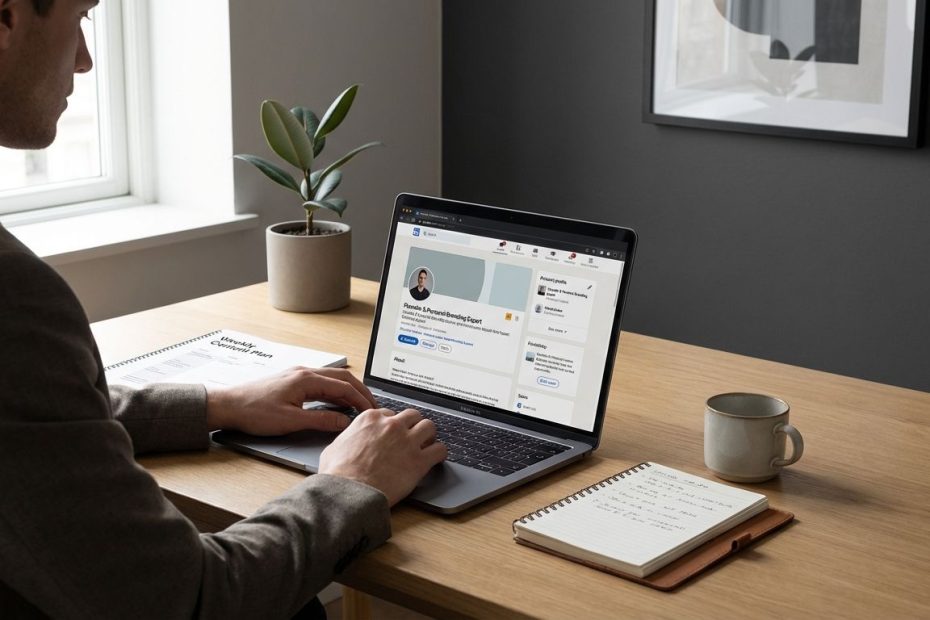
Treat the LinkedIn profile as a landing page, not a resume. It has one job: get the right person to understand what you do, trust that you can do it, and take the next step. That means clarity, proof, and keywords that match what your market searches, not clever branding language that sounds good internally.
Start with the headline. It must communicate role, audience, and outcome in plain language. Guidance from ACHE’s LinkedIn profile optimization material highlights practical steps that map to how LinkedIn search and skim-reading works: a customized URL for shareability, a headline that uses descriptive keywords, and an “About” section that tells a professional story aligned with goals. The headline is also the fastest comprehension element on the page, so it needs to answer, within seconds, why you matter.
Then fix the “About” section. Write it like a sales page with restraint: who you help, what problems you solve, what proof exists, and what to do next. Skip buzzwords, skip vague mission statements, and skip lists of traits. If there is credibility, show it: quantified outcomes, recognizable logos, clear role descriptions, and a short list of services or product categories you actually sell.
Use “Featured” as your proof vault. Add a case study, a product page, a demo clip, a talk, a high-performing post, or a customer story. Add media coverage only if it communicates credibility in your niche. Then clean the experience section so it reads like outcomes and scope, not like job descriptions. The profile should make it easy for the right person to self-qualify and message you with a relevant request.
What Should You Post As A Founder If You Don’t Want To Sound Cringe And You Don’t Have Huge Wins Yet?
Post operational truth with boundaries: what you built, what you learned, what you decided, and what changed your mind. Early-stage founders win by being specific and useful inside a narrow category. They do not need “big wins,” they need repeatable proof that they understand the buyer’s world and can execute.
A practical content menu keeps posting grounded in work, not performance. Publish build logs, decision memos, product lessons, customer objections and responses, teardown posts, and short updates about what shipped and why. These formats help you avoid generic advice and keep your voice tied to real activity. They also create a record that prospects and candidates can scan to understand how you operate.
Keep posts tight. Open with a clear claim, show one piece of evidence, state the implication, and end with a direct invitation that fits your role: “DM if this matches your situation,” “reply with your constraint,” or “happy to share the template.” LinkedIn’s personal branding trend guidance emphasizes authenticity and real stories, and that maps directly to founder content that performs without feeling forced.
Video works when it lowers friction for understanding. A simple talking-head clip that explains a tradeoff, a decision, or a customer lesson can outperform polished brand content because it transfers trust faster. LinkedIn’s video research materials also reinforce that story-driven video can drive connection and awareness, which is exactly what a founder needs when building familiarity with a buying group.
How Often Should You Post To Grow A Personal Brand Without Burning Out?
Pick a cadence that survives your worst month, not your best week. For many founders, that lands at two to four posts per week on one platform, with one longer asset every one to two weeks, like a newsletter or a video. Consistency beats volume because it keeps your audience trained to expect you, and it keeps you from binge-posting and disappearing.
Run a simple production system that fits founder constraints. Capture raw material from real work: customer calls, sales objections, product decisions, hiring lessons, and metrics that changed. Turn one weekly “hero idea” into several cuts: a LinkedIn post, a short clip, a newsletter paragraph, and a lightweight thread if that platform is in scope. Repurposing is not laziness, it is operational efficiency.
Protect execution time with rules. Set a hard time box for writing and recording. Use templates for recurring formats like build logs and decision memos. Avoid chasing impressions by changing your voice weekly. If a post performs well, repeat the format and raise the quality of the evidence, not the hype level.
Also separate “creator cadence” from “founder cadence.” Creators optimize for reach and engagement as the product. Founders optimize for trust touchpoints with the right titles and the right companies. A Forbes piece on young entrepreneurs using LinkedIn underscores practical steps like writing a headline that reflects focus and using the platform to build networks, it supports the broader point that clarity and consistency matter more than polish.
How Do You Measure ROI From Personal Branding So It Doesn’t Become Vanity Metrics?
Measure outcomes your business already respects: pipeline influenced, qualified inbound, partner intros, recruiting wins, speaking invites that map to target accounts, and improved response rates in outbound. Impressions and likes can be useful diagnostics, yet they cannot be the scoreboard. The scoreboard is whether the right people move faster because your credibility is already preloaded.
Create an attribution habit that takes minutes, not hours. Keep a simple log of meaningful inbound: who reached out, what they referenced, what platform they came from, and what the next step became. Over a few weeks, patterns appear, and those patterns tell you what content themes produce real business movement. This is how personal brand work becomes a controlled growth loop rather than an endless posting treadmill.
For B2B, research from Edelman and LinkedIn connects thought leadership to consideration-stage movement, including prompting buyers to research offerings they were not previously considering. That suggests practical proxy metrics: branded search lift, increased profile views from target roles, more “we have been following you” messages, and higher reply rates on outbound that references your content. LinkedIn and Edelman’s newer research also highlights the role of buying groups and “hidden buyers,” reinforcing that founder visibility can influence stakeholders beyond the obvious champion.
Build a founder-grade dashboard with leading indicators and lagging outcomes. Track weekly qualified DMs, booked calls attributed to content, and recruiting inbound. Track monthly partner intros, invite rate for podcasts or talks aligned to your market, and pipeline influence. Track quarterly conversion lift in outbound, win rate changes when content is shared during a deal, and time-to-hire improvements from stronger inbound candidate flow.
How Do You Build A Founder’s Personal Brand Online?
- Pick one platform
- Clarify audience and outcome
- Optimize profile for search and proof
- Post useful build-and-learn content weekly
- Track qualified inbound and pipeline influenced
Turn Your Name Into A Growth Asset
A powerful founder brand is a system: clear positioning, a profile that converts, content tied to real work, and measurement tied to revenue, hiring, and partnerships. When you choose one primary channel, publish proof-based updates consistently, and keep your message aligned with your buyer’s real constraints, trust builds without theatrics. The outcome is faster warm starts in sales, stronger inbound talent, and more leverage in partnerships because your credibility travels ahead of you. Implement a 90-day plan, review signals every week, and tighten the loop until the brand produces predictable business outcomes.
References
- Reddit: Do we really need a personal brand as business owners or is it all a scam designed to democratize attention for existing business whales?
- LinkedIn: Reach Beyond The Ready: B2B Thought Leadership Research From LinkedIn and Edelman
- LinkedIn: How B2B Marketers Can Use Thought Leadership to Persuade Hidden Buyers
- LinkedIn: 2025 Media Trends for Personal Branding
- ACHE: Optimize Your LinkedIn Profile Handout
- Reddit: How do I promote my brand? Where should I start?
- Reddit: Building a LinkedIn Personal Brand – 7.5k Impressions in 28 Days
- Forbes: How Young Entrepreneurs Are Building Their Brand And Network On LinkedIn
- Reddit: Personal branding strategy that generated $47K in opportunities

Yitz Stern is a New York–based entrepreneur and business consultant with 20+ years of experience in alternative funding and real estate. A former CEO of Fundry and managing director at Tiger Financial Technologies, he now advises mid- to large, non-public companies on capital strategy and scalable growth while investing in multifamily real estate